
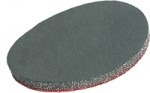
 Mirka Abralon Foam-Backed Discs will win you over the first time you try them. They are so flexible, and can contour to surfaces better than any other sanding disc I’ve tried.
The face of the disc is a very thin and pliable knitted fabric material (Mirka’s literature does not make mention of what the material is made of). From the magnified shots I’ve seen, it appears that each strand is made up of eight very thin individual strands (not twisted). Individually, each strand can contour to odd surfaces, yet because they are bunched in sets of eight, Abralon Discs also give the material impressive strength. Thanks to the design, liquids and abraded residue are able to migrate between the strands.
Silicon Carbide abrasive grains are attached to each strand, so as the disc changes shape, contouring to surface nuances, there is a high likelihood that at least some scrubbing power will be available at all times. Silicon carbide is a relatively inexpensive material when produced (natural silicon carbide is somewhat rare, thus expensive), yet it is nearly as hard as a diamond! Therefore, if you don’t abuse Abralon Discs by using too much pressure or speed (when machine sanding), the will last a long time.
The integrated foam center of the disc serves triple-duty. First, it helps to distribute applied pressure, which delivers a more consistent cut across the face of the disc. If you happen to be sanding by hand and are not using a sanding pad, the foam will help to minimize finger ridges (marks that form in the sanding surface due to concentration of pressure at the tip of each finger). Next, the foam is able to store large amount of liquids (water, oils, or solvents), which helps keep the disc clean, and the sanding surface lubricated. Finally, the foam adds cushioning, which allows the fabric face of the to stay in contact with virtually any surface shape.
The “grip” or loop backing is compatible with all hook-type backing pads & plates.
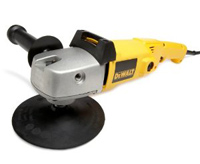 As of late, there have been substantial advances in the world of paint polishing. Discussions pertaining to compounds, polishes and pads (and the methods used to polish automotive paint) riddle the various detailing forums on the Web. It is an exciting time in our little world, and many of us that partake in the online dialogue really take the debates to heart.
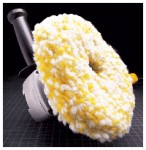 Ah, the buffing pad. So many variations, so many uses. Comparatively, they are the equivalent of sockets in the hand tool realm. A mechanic may only own a handful of ratchets, but will typically line his tool chest with dozens, or even hundreds of sockets.
 Originally, the
 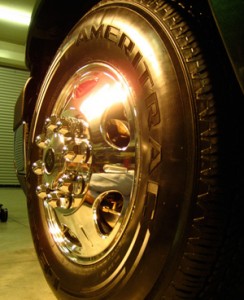 The next time you need to polish aluminum, chrome, or stainless steel, give
 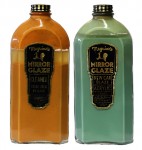 When a question arises pertaining to Meguiar’s products, would you care to wager what question I hear the most? No need to risk your dough, because the answer is in the title of this post: “Why does Meguiar’s make so many products?!”
 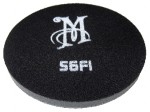 When machine sanding, an interface pad is placed between the sanding disc and backing plate. Its job is to allow the sanding disc to flex, so that it can contour to curved or oddly shaped surfaces. Of course, if a sanding disc features a stiff backing, it will not flex as readily as a sanding disc featuring a soft backing.